Open Klaviyo. Set the range to the last 90 days. Put campaign revenue next to flow revenue and look at the two numbers together.
For most stores we see, campaigns are earning somewhere north of 80% of it. Almost every owner reads that as good news. The campaigns are working, so send more of them.
It is not good news. It is a running cost you have not priced.
The two numbers mean different things
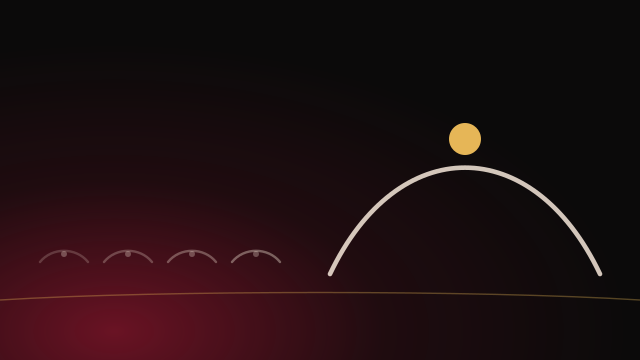
A campaign earns on the day you send it. To earn again next week you write another one, pick the segment, build it, proof it, send it. Stop for a month and the revenue stops with you. Campaign revenue is rented.
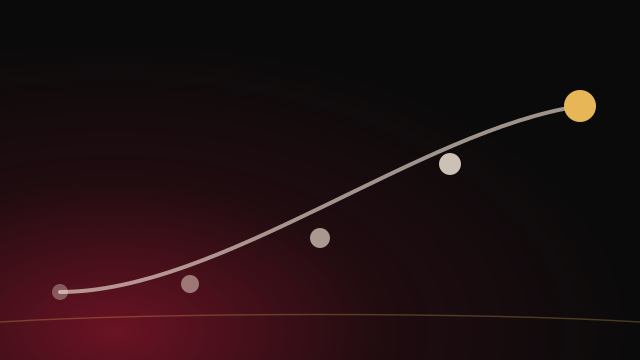
A flow earns because a customer did something. They abandoned a cart, bought for the first time, went quiet for 60 days. You build it once and it keeps running against people you have not met yet. Flow revenue is owned.
So a store at 85% campaigns is not a store with strong email. It is a store whose email income is tied to how much someone felt like working that month. The moment attention moves, so does the revenue.
What the split should look like
There is no single correct ratio, and anyone who gives you one has not looked at enough accounts. It moves with how often you launch, how considered the purchase is, and how big your list is relative to your traffic.
But the shape is consistent. A store with its automation actually built earns somewhere between a third and a half of email revenue from flows, on a fraction of the sends. A store at 10% flows is not underperforming on campaigns. It has a hole where its automation should be.
The fastest way to see it: divide revenue by emails sent, for flows and for campaigns separately. Flows almost always win by a wide margin, because they arrive when someone is already thinking about you rather than when the calendar said Tuesday.
Why it stays broken
Nobody decides to skip flows. They get skipped because of how the work feels.
A campaign has a deadline. There is a launch, a holiday, a restock, and something has to go out on Thursday. A flow has no deadline at all, so it loses every week to the thing that does. That is the whole mechanism.
The second reason is that flows are boring to build and invisible when they work. A campaign gives you a spike in the dashboard the same afternoon. A well-built welcome sequence gives you a slightly better month, six weeks later, in a number nobody was watching.
Where to start, in order
- Abandoned checkout. Highest intent anyone will ever show you. If this is one email, it should be three.
- Welcome. Most brands send one email and never mention what makes them different from the store the customer just came from.
- Browse abandonment. Cheap to build, and it catches people well before checkout.
- Post-purchase. The window where a first-time buyer is most likely to become a second-time buyer, and the one almost everyone leaves empty.
- Winback. Only worth building once the four above are live, because it works on the people those four failed to keep.
That order is deliberate. It runs from highest intent to lowest, so the earliest work pays first and funds patience for the rest.
The part that is actually hard
None of the above is secret. Every Klaviyo agency will tell you the same list, and most store owners already know it.
Knowing is not the constraint. The constraint is that building five flows properly means writing roughly 20 emails, in your brand's voice, with the right products in each, then watching them for a few months and changing what underperforms. That is a job. It competes with the launch on Thursday, and it loses.
Which is the actual reason we built a machine to do it instead of hiring people to do it. Not because a person cannot write a good welcome flow. Because the flow that never gets built earns nothing, and the thing that never gets built is always the thing with no deadline.
If you want to know what your own split is and what it would take to move it, that is a 15-minute conversation and you do not need to buy anything at the end of it.